Thursday, April 24, 2014

Chapter 15

Therapy
"Cognitive-behavioral therapy, a widely practiced integrative therapy, aims not only to alter the way people think (cognitive therapy), but also to alter the way the act (behavior therapy). It seeks to make people aware of their irrational negative thinking, to replace it with new ways of thinking, and to practice the more positive approach in everyday settings. Behavioral change is typically addressed first, followed by sessions on cognitive change; the therapy concludes with a focus on maintaining both and preventing relapses... 'The trouble with most therapy is that it helps you to feel better. But you don't get better. You have to back it up with action, action, action.' (Therapist Albert Ellis (1913-2007)." -- Page 687
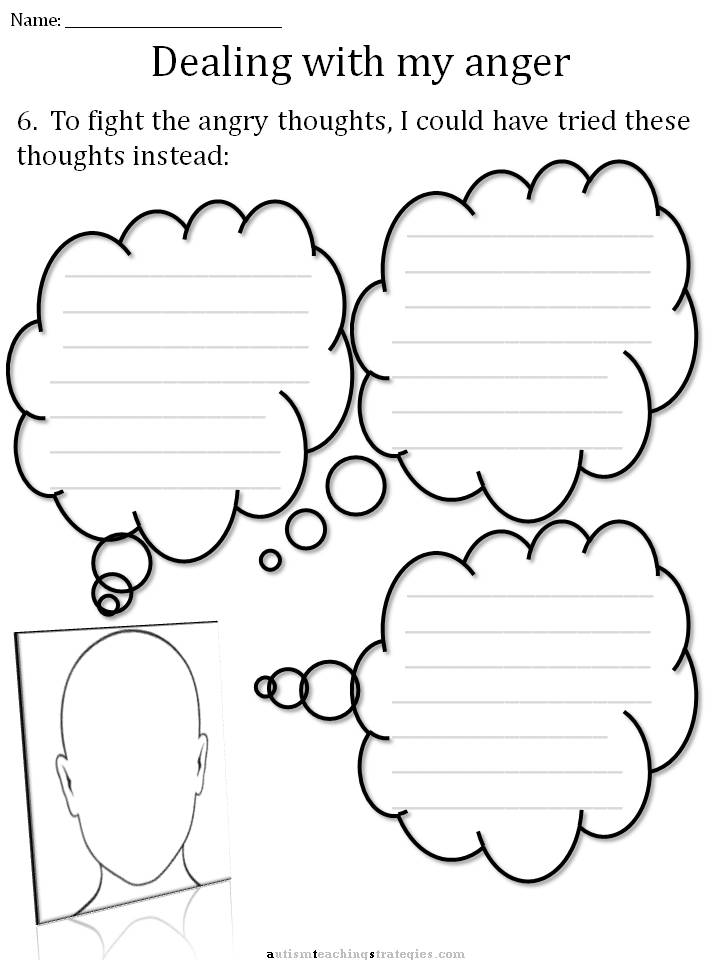
Cognitive-behavioral therapy can be useful for any age group. This worksheet was pulled from a children's workbook for cognitive-behavioral therapy, and aims to get the child to rethink alternative ways to react instead of the initial negative, angry thoughts they have been comfortable initially reacting with. While it seems childish, the therapy can work... I, personally, have not ever gone through this type of therapy. However, I've somehow gained the ability to alter the way I both think and act in the last week, alone. Something internally shifted, and suddenly I find myself extremely self-aware of the way I'm thinking, purposefully working to think more positive thoughts and see the bright side of things. With this new mentality, although difficult at times, I find myself more ambitious, more productive, and more enjoyable to be around by others. This change in me has sparked a chain reaction in my interactions with my immediate family, and most especially, my boyfriend. It creates a more positive outlook on life, and prevents a lot of fights that result from literally the most minute of aspects.

Chapter 14

Psychological Disorders
"Coughing, vomiting, swelling, and pain protect the body from dangerous toxins. Similarly, depression is sort of a psychic hibernation: It slows us down, defuses aggression, helps us let go of unattainable goals, and restrains risk taking (Andrews & Thomson, 2009a,b; Wrosch & Miller, 2009). To grind temporarily to a halt and ruminate, as depressed people do, is to reassess one's life when feeling threatened, and to redirect energy in more promising ways (Watkins, 2008). Even mild sadness can improve people's recall, making them more discerning, and help them make complex decisions (Forgas, 2009). There is sense to suffering." -- Page 645

At face value, this song is a great piece by Kelly Clarkson, former American Idol winner. However, underneath the notes, the pretty face, and the filmography to pair with the music, there are words that express deep, extremely complicated feelings that are difficult to express in any other way than by song. Kelly sings about being stuck in a physically and emotionally draining relationship that pushes one into a dark state of depression. To me, I was the girl in this song... No, I'm not saying I am a girl; I'm saying I was once stuck in the mud, bore into a bottomless hole of darkness where fear took control and was my source of motivation to stay out of the way of my boyfriend. However, while down so far, the depression allowed me to regroup, gain some sort of inner composure and strength, and begin the painstakingly challenging climb back into the light. It gave me the ability to formulate ideas, grab hold of them, and follow through in order to regain control of me, my life, and my environment. No longer affected by depression, I can look back and see the old me, restricted and caged, and be appreciative that my body allowed me the chance to reassess the horrid situation I was so hatefully stuck in.

Chapter 13

Social Psychology
"Deindividuation thrives, for better of for worse, in many different settings. Tribal warriors who depersonalize themselves with face paints or masks are more likely than those with exposed faces to kill, torture, or mutilate captured enemies (Watson, 1973). Online, Internet trollers and bullies, who would never say 'You're a fraud' to someone's face, will hide behind anonymity. Whether in a mob, at a rock concert, at a ballgame, or at worship, when we shed self-awareness and self-restraint, we become more responsive to the group experience -- good or bad." -- Page 588

V, the main character in the film V for Vendetta, completely removes himself, including all emotions and identity, from his environment. In place of identity, he portrays himself as an idea. In a dystopian government-dictated Britain, he acts as a freedom fighter and hides behind the mask and cloak. He avenges bad guys that attempt to restrict freedom, and since he is hidden, his true identity remains anonymous, therefore creating a disassociation with the actions he is committing.

Chapter 12

Personality
"Authentic pride that's rooted in actual achievement supports self-confidence and leadership (Tracy et al., 2009; Williams & DeSteno, 2009). Self-serving perceptions underlie conflicts ranging from blaming one's spouse for marital discord to arrogantly promoting one's own ethnic superiority. Finding their self-esteem threatened, people with large egos may do more than put others down; they may react violently. 'Aryan pride' fueled Nazi atrocities. 'These biases have the effect of making wars more likely to begin and more difficult to end,' note Daniel Kahneman and Jonathan Renshon (2007)." -- Page 566

Gay culture has grown to be more acceptable in today's society. However, it is no where near acceptable enough to be able to be openly accepted by everyone. Many gay people lack the confidence to embrace their pride in who they are, which is fed by the strong arrogance portrayed in the heterosexual culture. Confidence is something that, in general, the gay culture seems to lack a lot of. The man in this image, barely clothed, symbolizes a slow change in the shift from a lack of confidence to being full of confidence, unafraid to embrace his pride in who he is, and also be seen with the infamous rainbow flag that symbolizes the ongoing struggle. I, a gay man, am no longer afraid. I've built up the strength to stand against the heterosexual culture, embracing my "authentic pride" in who I am -- a confident, proud, gay man.

Chapter 11

Emotions, Stress, and Health
"Does exercise also boost the spirit? Many studies reveal that aerobic exercise can reduce stress, depression, and anxiety. Americans, Canadians, and Britons who do aerobic exercise at least three times a week manage stress better, exhibit more self-confidence, feel more vigor, and feel less depressed and fatigued than their inactive peers (McMurray, 2004; Mead et al., 2010, Puetz et al., 2006). And in a 21-country survey of university students, physical exercise was a 'strong' and consistent predictor of life satisfaction (Grant et al., 2009). -- Page 522

In this video, Tracy Anderson demonstrates an intensive aerobic exercise. This sort of exercise releases large amounts of endorphins, which help bring an upbeat, positive attitude to the table in people. I can relate to this concept. As a runner, I find myself to be in a more positive and less stressed mentality. Due to this, when faced with high stress situations, I am better able to move forward through the stress, and not be so bogged down an anxious in the end. It definitely contributes to my ability to maintain inner strength during hard times.

Chapter 10

Motivation and Work
"So, human motivation aims not to eliminate arousal but to seek optimum levels of arousal. Having all our biological needs satisfied, we feel driven to experience stimulation and we hunger for information. We are 'infovores,' says neuroscientists Irving Biederman and Edward Vessel (2006), after identifying brain mechanisms that reward us for acquiring information. Lacking stimulation, we feel bored and look for a way to increase arousal to some optimum level. However, with too much stimulation comes stress, and we then look for a way to decrease arousal." -- Page 420

This image below fully exemplifies the human thirst for stimulation. When needs are completely satisfied that enable us to fully function and meet needs for survival, we want to experience fun excitement. I have always wanted to try new things. While I'm not sure skydiving is exactly that, I seek stimulation in the form of roller coasters. This stimulation keeps me on the edge of my seat in life, and prevents me from falling into a statement of prolonged boredom. I'm always looking for new and exciting things to do to keep my stimulation and knowledge pepped and energized, providing a nice balance to the amount of work I seem to always have to do.

Chapter 9

Thinking, Language, and Intelligence
"Bilingual individuals may even reveal different personality profiles when taking the same test in their two languages (Dinges & Hull, 1992). This happened when China born, bilingual University of Waterloo students were asked to describe themselves in English or Chinese (Ross et al., 2002). The English-language self-descriptions fit typical Canadian profiles: Students expressed mostly positive self-statements and moods. Responding in Chinese, the same students gave typically Chinese self-descriptions: They reported more agreement with Chinese values and roughly equal positive and negative self-statements and moods. 'Learn a new language and get a new soul,' says a Czech proverb." -- Page 376

This film exemplifies how this Mexican student felt exiled not understanding the English language. He demonstrated possible reason as to why, when speaking in a native language, it could be perceived as though the self-statements are more neutral, equally weighted in positive and negative sides. Once the new language was understood and conceptualized, he became exceptionally self-confident and excited. Due to this, it could be understood that why, when the English language was grasped, it would appear that one could be very high in self-statements of overall positiveness. I can see it in my boyfriend, bilingual in both English, his native language, and German, a learned second language through academics. When he speaks of himself in English, he is not overly positive or negative in self-statementing. When he speaks in German, he seems to be more confident, proud that he conquered a foreign concept.

Chapter 8

Memory
"Architects make miniature house models to help clients imagine their future homes. Similarly, psychologists create memory models to help us think about how our brain forms and retrieves memories. Information-processing models are analogies that compare human memory to a computer's operations. Thus, to remember any event, we must: a) get information into our brain, a process called encoding; b) retain that information, a process called storage; and c) later get the information back out, a process called retrieval. Like all analogies, computer models have their limits. Our memories are less literal and more fragile than a computer's. Moreover, most computers process information sequentially, even while alternating between tasks. Our dual-track brain processes many things simultaneously (some of them unconsciously) by means of parallel processing." -- Page 314

This image serves as a visual aid to what the brain does during information processing. Humans see, hear, and experience hundreds of thousands of things a day. The brain sees and identifies each and every one of those things, determining the level of importance of that concept based on how long the concept was exposed to the person, the intensity of which it was exposed at, and if it makes reappearances often. This picture shows hundreds of objects, color-coded and segmented to symbolize the way the brain sees things and memorizes them, filing them away in specific locations until retrieval is necessary and called upon by the person.

Chapter 7

Learning
"Psychologists define learning as the process of acquiring new and relatively enduring information or behaviors. By learning, we humans are able to adapt to our environment. We learn to expect and prepare for significant events such as food or pain (classical conditioning). We typically learn to repeat acts that bring rewards and try to avoid acts that bring unwanted results (operant conditioning). We learn new behaviors by observing events and by watching others, and through language we learn things we have neither experienced nor observed (cognitive learning). But how do we learn?" -- Page 276

This video of 4-year-old elephant Suda demonstrates the ability to learn. When reading about how elephants learn, it is much the same as humans. Suda, the particular elephant of focus in this video, learned by observing her trainers on how to paint. Since she does not have hands, she was able to adapt to what her environment, utilizing a trunk instead of a hand to hold a brush and paint something that is familiar to her. Later in the video viewers can see the ability of Suda to spell her name as she signs the piece of art. Elephants are much like humans; they learn by a combination of experiencing events and learning from them for the future, seeking rewards for their actions, and learning through extensive observation of those things and objects in their surroundings. Constant praise from trainers demonstrates the innate ability to learn from verbal praise and reward systems... And the result is an incredible display of awe as the elephant acts just as humans.

Chapter 6

Sensation and Perception
"To analyze a visual scene, the brain divides it into subdimensions -- color, motion, form, depth -- and works on each aspect simultaneously (Livingstone & Hubel, 1988). We then construct our perceptions by integrating the separate but parallel work of these different visual teams. To recognize a face, your brain integrates information projected by your retinas to several visual cortex areas, compares it to stored information, and enables you to recognize the face: Grandmother!" -- Page 239-240

This video aims to depict what the eye sees and how the brain works to process it. So much happens in front of a single pair of human eyes. As he says in the clip, "to understand is to perceive patterns." Everything humans see in is in some sort of recurring pattern form; they are just layers and layers of patterns: patterns of color, patterns of motion, patterns of form, and patterns of depth. The human brain works hard to piece all of these pieces together by parallel processing. When these pieces are placed together, a large image is seen, one that the brain processes from the eyes and allows verbal and mental recognition. This processing that occurs gives way to appreciation of the world one exists within.

Tuesday, April 22, 2014

Chapter 5

Developing Through the Life Span
"To refine their sense of identity, adolescents in individualistic cultures usually try out different 'selves' in different situations. They may act out one self at home, another with friends, and still another at school or on Facebook. If two situations overlap -- as when a teenager brings friends home -- the discomfort can be considerable. The teen asks, 'Which self should I be? Which one is the real me?' The resolution is a self-definition that unifies the various selves into a consistent and comfortable sense of who one is -- an identity." -- Page 203


The girl drawn in this image is a perfect representation of the adolescent formation of identity. Often times, children, especially teenagers, tend to share their emotions and feelings through the art of drawing. The girl in this image is without a face to symbolize the confusion of who she is, or moreover, when she has to be which person. I felt like this a lot myself during my adolescence -- I am gay, however back during my adolescence, I was unaware of who to be or how to be each person, especially my true identity as a homosexual. Therefore, I was often confused of who to be when. Much like my situation, the girl depicted in this piece of artwork demonstrates the search for unification between all forms of the self, so that the blank canvas surrounded by hair can be filled in with all the beautiful features of a face.

Chapter 4

Nature, Nurture, and Human Diversity
"During early childhood -- while excess connections are still on call -- youngsters can most easily master such skills as the grammar and accent of another language. Lacking any exposure to language before adolescence, a person will never master any language. Likewise, lacking visual experience during the early years, those whose vision is restored by cataract removal never achieve normal perceptions." -- Page 149

This image depicts the experiences in which a normal human exists within the boundaries of. All people are exposed to a vast array of other people, places, objects, sounds, sights, et cetera. These experiences are taken in through a person's Five Senses - sight, touch, taste, smell, and hear. All of these experiences build up an adolescent's brain development. The exposure, as an adolescent, helps the brain cells associated with all of these sense one experiences to further flourish and develop, gaining strength and formulating the proper connections necessary to further develop as the adolescent grows beyond the childhood stage. 

Monday, April 21, 2014

Chapter 3

Consciousness and the Two-Track Mind
"Sleep patterns are also culturally influenced. In the United States and Canada, adults average 7 to 8 hours per night... North Americans are nevertheless sleeping less than their counterparts a century ago. Thanks to modern light bulbs, sift work, and social diversions, those who would have gone to bed at 9:00 PM are now up until 11:00 PM or later. With sleep, as with waking behavior, biology and environment interact." -- Page 97

Everyone believes that the ideal amount of sleep is 8 hours. However, this myth is untrue. Sleep patterns are affected by everything externally as well as what is internal. Genetically, humans are influenced to get enough sleep as suggested by their body to maintain a healthy life. Externally, technology and distraction influences human sleep patterns, prevent the ability to get the amount of sleep the body truly needs. It's important that one figure out the pattern that best suits him or her in order to increase productivity and maximize the time spent awake so that sleep is effective, as well.

Sunday, April 20, 2014

Chapter 2

The Biology of Mind
"What about the 99.99+ percent of us with undivided brains? Does each of our hemispheres also perform distinct functions? Several different types of studies indicate they do. When a person performs a perceptual task, for example, brain waves, bloodflow, and glucose consumption revealed increased activity in the right hemisphere. When the person speaks or calculates, activity increases in the left hemisphere." -- Page 79

This Mercedes advertisement demonstrates the way in which the left and right brain work simultaneously to create a fully functioning human. On the left, everything is very angular, crisp, and sleek. However, the image on the left shows a lot more freedom of creativity, color, free spirit and passion. When our brains are calculative, we think more from the left side, however when faced with a task free of regulation or requirement, we think from the creative right side. The ad emulates an otherwise textbook definition of the left and right brain, creating an image of the brain segmentation that proves much more memorable and descriptive. While we have different parts of the brain for different functions, they all work together to power our daily life.

Chapter 1

Introduction to the History and Science of Psychology
"... Yet over and over again we will see that in contemporary science the nature-nurture tension dissolves: Nurture works on what nature endows. Our species is biologically endowed with an enormous capacity to learn and adapt. Moreover, every psychological event (every thought, every emotion) is simultaneously a biological event." -- Page 7


This video identifies how to let children determine what works for them, instead of having their environment dictate what characteristics and skills they should be best at. From how a child learns to like writing or drawing better, they should be exposed to both so that their skills and preferences can be established based on their needs and interpretations. While the genes may have certain pull in how these skills develop, the child may be able to develop and sharpen skills not fully equipped by the nature side of things. This further demonstrates the joint play that nature and nurture have with each other.